
Overtime calculator
Work out what your overtime hours are worth with the free calculator from TimeTac, at time and a half, double time or any rate you set.
Use the calculator to
- work out overtime pay for a week or a month
- see the rate per overtime hour instead of guessing at it
- compare time and a half against double time
- keep regular pay and overtime pay apart on the same screen
What goes in
Regular pay: your hourly rate for normal hours
Regular work time: the hours you normally work in the period
Overtime hours worked: the hours on top of that
Overtime pay factor: the multiplier as a percentage. 150 % is time and a half, 200 % is double time
What comes out: total regular pay, the overtime rate per hour and total overtime pay. All figures are gross.
The calculator is set up for a month. For a week, enter weekly figures in every field and the result covers that week.
How overtime pay is calculated.
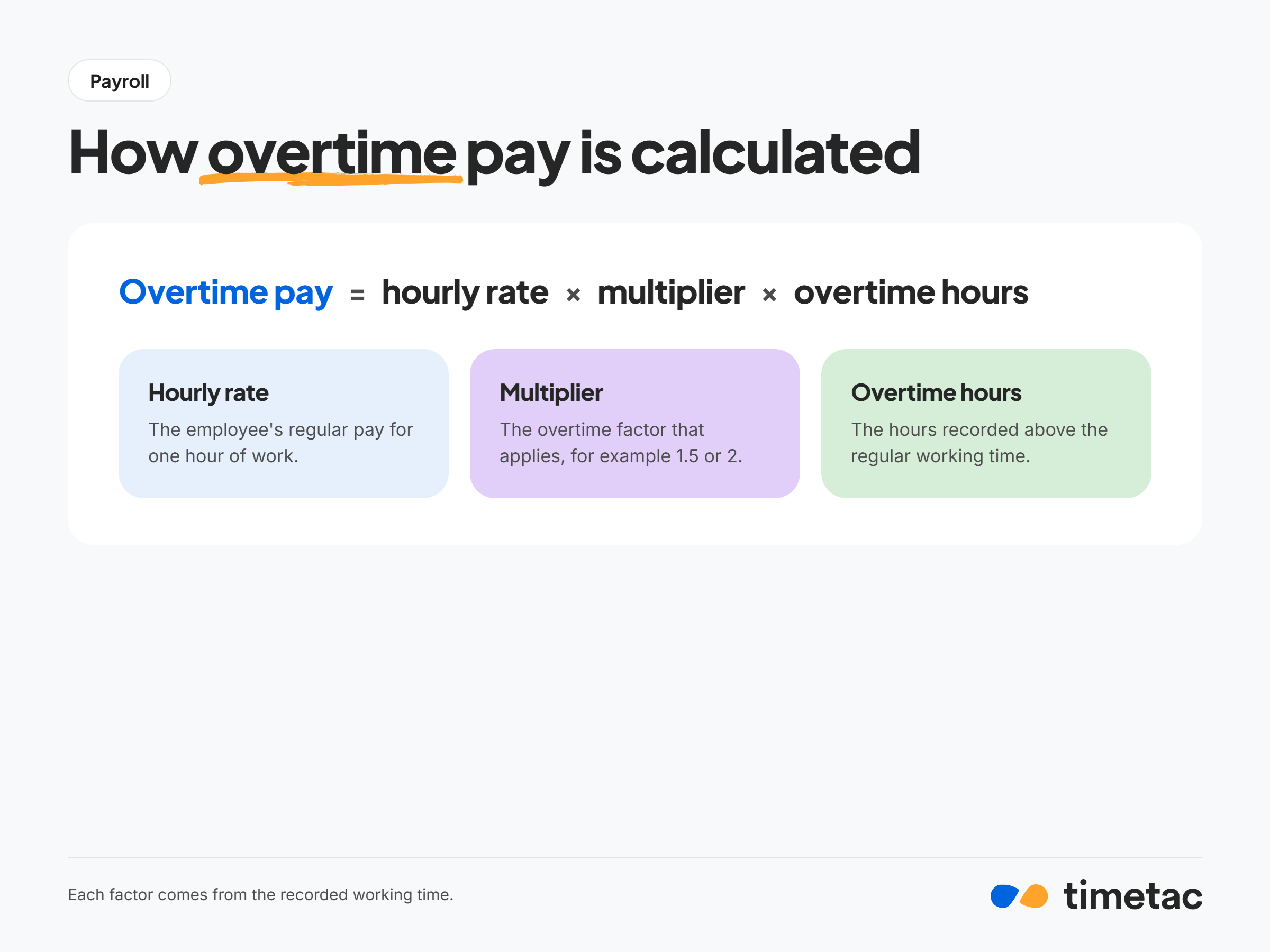
Multiply your hourly rate by the multiplier, then by the number of overtime hours.
Overtime pay = hourly rate × multiplier × overtime hours
Example. An hourly employee earns $15 and works 45 hours in a week, 5 of them overtime, at time and a half:
- Regular pay: 40 hours × $15 = $600
- Overtime pay: 5 hours × $15 × 1.5 = $112.50
- Total: $712.50
Frequently asked questions.
What is the overtime formula?
Hourly rate × multiplier × overtime hours. At $20 an hour and time and a half, ten overtime hours come to $300.
Is overtime 1.5 or 2x?
Time and a half is generally the standard, and under US federal law it is the minimum for nonexempt employees. Double time is usually not required by law, though it appears in state rules, union agreements and company policies, often for long shifts or holidays.
Is overtime counted by the day or by the week?
By the week under federal law, for hours over 40. Several states add daily rules, so check the law where the work is done.
Who is eligible for overtime pay?
Generally employees classified as nonexempt, which covers most hourly staff. Classification depends on pay level and job duties rather than job title, so the answer for any individual comes from their contract and the law where they work.
How do you calculate time and a half?
Multiply the hourly rate by 1.5. At $18 an hour, each overtime hour pays $27.
Does the calculator show gross or net pay?
Gross. Tax and deductions depend on your situation, so the net figure has to come from payroll.
Do these rules apply to me?
Please treat everything on this page as general information rather than legal or tax advice. Overtime rules differ by country, state and employment agreement, and what applies to you is set out in your contract, any collective agreement and the law where you work.
Last reviewed in September 2026.
